Best Dog Parks Near Me · July 10, 2026
Why Small Dog Areas Exist (and When to Use One)
Ask around a dog park and you'll hear the small-dog area described as optional, or as a courtesy for nervous owners. The design exists for a more specific reason, and it's worth understanding before deciding your terrier can handle the main pen.
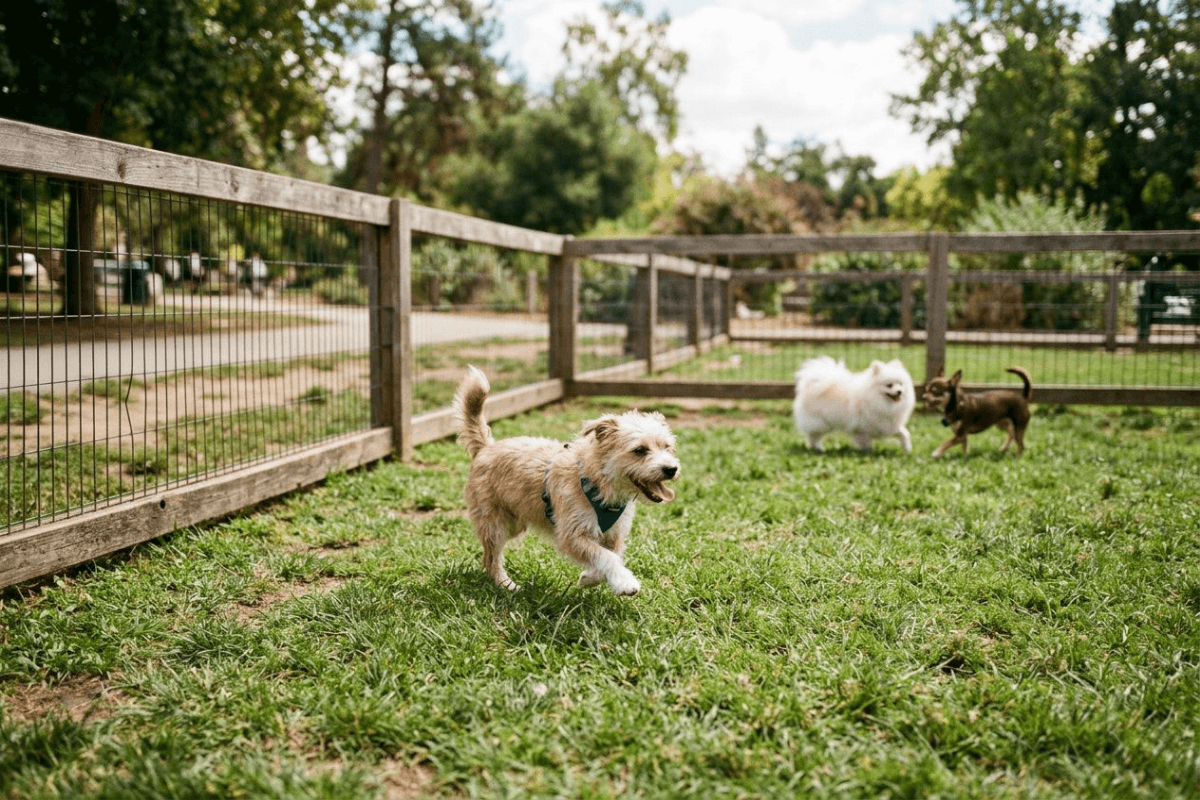
Size mismatch is the injury risk
The serious injuries at dog parks are overwhelmingly not the result of a fight between two evenly matched dogs. They are the result of a large dog and a small dog interacting, often with no aggression involved at all. A body slam that a labrador exchanges cheerfully with another labrador is a crushing impact to a ten-pound dog. A grab-and-shake that is ordinary play between two big dogs can break a small dog's spine.
The large dog in these incidents is usually behaving normally and the owner is usually horrified. That is precisely the point: no amount of temperament screening prevents a physics problem.
Predatory drift
There is a second, less intuitive risk. A small dog running away and squealing can, in some large dogs, trigger a chase-and-grab sequence that belongs to a completely different behavioral system than play. Trainers call this predatory drift. It is sudden, it is not preceded by the warning signals that precede a fight, and it can occur in dogs with no history of aggression toward anything.
It is rare. It is also the scenario the small-dog fence is really designed for, and the reason experienced trainers are firm about the rule in a way that can seem disproportionate.
Where the line falls
Most parks that separate by size post a weight limit, commonly somewhere around 25 or 30 pounds. Where the limit is posted, use it, even if your dog is confident and even if the large-dog pen looks calm. The rule protects your dog against a dog that isn't there yet.
Where no line is posted, the useful question isn't your dog's weight. It's whether a dog in the main pen outweighs yours by a factor of three or more. That ratio, rather than any absolute number, is where the physics turns against you.
The big dog in the small pen
Owners of gentle large dogs sometimes use the small-dog area because it's quieter. It's worth being blunt: this defeats the purpose of the enclosure entirely, and it puts the small dogs whose owners chose that pen for safety at exactly the risk they were avoiding. A gentle labrador is still a labrador-shaped object moving at twenty miles an hour.
If the main pen is too rowdy for your large dog, the answer is a different time of day or a different park, not the small pen.
Small dogs have their own dynamics
A small-dog pen is not automatically a gentle place. Small dogs fight, guard, and bully each other exactly as large dogs do, and their owners are markedly less likely to intervene, because a squabble between two chihuahuas doesn't look dangerous. It is still teaching both dogs something. The body-language signals to watch for are identical to those in the main pen, and our guide to reading play versus stress applies at every size.
Finding a park with one
We tag listings with a Small dog area badge where the source data or visitor reviews confirm a separate enclosure. If your dog is small, it is one of the few features genuinely worth driving farther for. A park without one isn't unsafe by default, but it does mean the responsibility for managing size mismatch falls entirely on you and on the owners around you.