Best Dog Parks Near Me · July 10, 2026
Reactive Dogs and Dog Parks: The Honest Answer
If your dog lunges, barks, or freezes at the sight of another dog, someone has told you to take them to the dog park so they can get used to other dogs. It is the most common piece of advice given to owners of reactive dogs, and for most of those dogs it makes the problem worse.
This article is not a training program, and reactivity is a case where a qualified trainer or veterinary behaviorist who has watched your specific dog is worth far more than anything written for a general audience. What follows is why the dog park is the wrong tool.
Reactivity is usually fear, not aggression
A reactive dog is typically over-aroused and under-confident. The barking and lunging is distance-increasing behavior: the dog is trying to make the frightening thing go away, and it usually works, which is why the behavior persists. Interpreting it as aggression leads to punishment, and punishing a frightened dog for warning you teaches them to skip the warning.
Why a dog park makes it worse
Behavior change in a fearful animal requires the animal to stay below the threshold at which they panic. Below threshold, a dog can notice another dog, feel fine, and gradually learn that dogs predict good things. Above threshold, the dog is not learning anything except that they were right to be afraid.
A dog park is an environment specifically designed to put a reactive dog far above threshold: many unfamiliar dogs, no distance control, no escape, high arousal, and a fence that prevents the one strategy the dog has. It is the equivalent of curing a fear of heights by pushing someone off a building. Repeated exposure at that intensity is called flooding, and it tends to produce a dog who has shut down rather than a dog who has learned.
Then there's the risk to everyone else. A frightened dog with no escape route may bite, and the other dogs at the park did not consent to that experiment.
What distance actually does
For almost every reactive dog there is a distance at which they can see another dog and stay calm. It might be two hundred feet. That distance is the entire training environment. Work happens there, and only there, and the distance shrinks over weeks and months as the dog's association with other dogs changes.
You cannot control distance inside a dog park. You can control it completely on a wide trail, in an empty field, or in a parking lot across the road from a park at a quiet hour, watching dogs come and go while your dog eats good food and nothing bad happens.
The dog park's useful role for a reactive dog
It's not a place to go in. It's a reliable, predictable supply of dogs at a controllable distance. A bench across the street from a fenced park, at a time when the park has three dogs rather than thirty, is one of the better training environments available, and it costs nothing.
Empty parks have a second use. Some fenced dog parks are genuinely empty at certain hours, and a securely fenced, empty space is a rare and valuable thing for a dog who cannot be let off leash anywhere else. Check the park's quiet hours, arrive, and if there's another dog there, leave without going in. Some cities and private landowners also rent out fenced fields by the hour for exactly this purpose.
What a reactive dog needs instead
- Distance, always. Cross the street. Turn around. Nothing is lost by avoiding a trigger today.
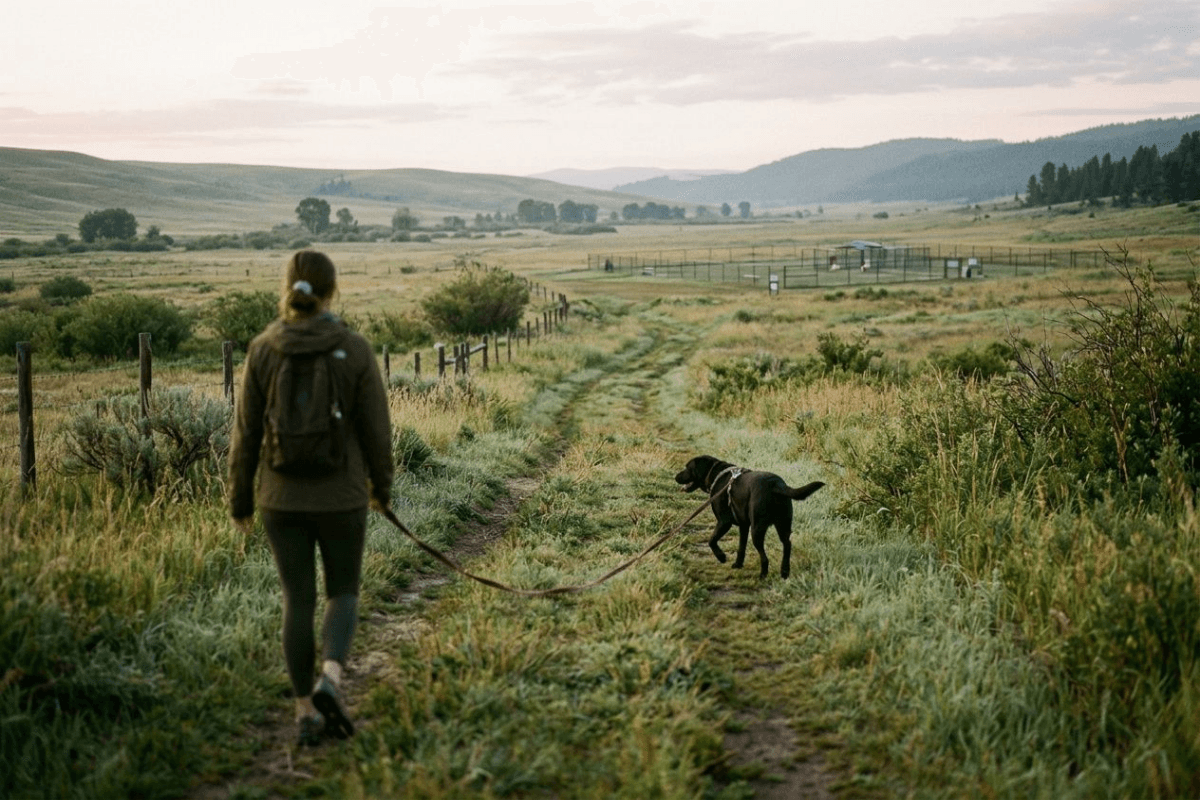
- Sniffing, on a long line. Scent work is genuinely calming and tires a dog more than running. A quiet trail at a dead hour beats any park.
- One or two known dog friends. A single calm, familiar dog on neutral ground does more for a dog's social life than a crowd ever will.
- Professional help early. Reactivity responds well to structured behavior work and sometimes to veterinary support. It rarely responds to time alone.
Letting go of the dog park
Owners of reactive dogs often carry real grief about this, and a sense that they've failed their dog by not being able to do the normal thing. A dog does not need a dog park. A dog needs exercise, mental work, safety, and the company of the person they love. Plenty of extremely happy dogs have never met an unfamiliar dog off leash in their lives.