Best Dog Parks Near Me · July 10, 2026
Dog Parks in Hot Weather: What Actually Puts Dogs at Risk
A summer afternoon that feels pleasant to you can be dangerous to a dog running flat out on hot ground. The mismatch has three causes, and understanding them is more useful than any temperature threshold.
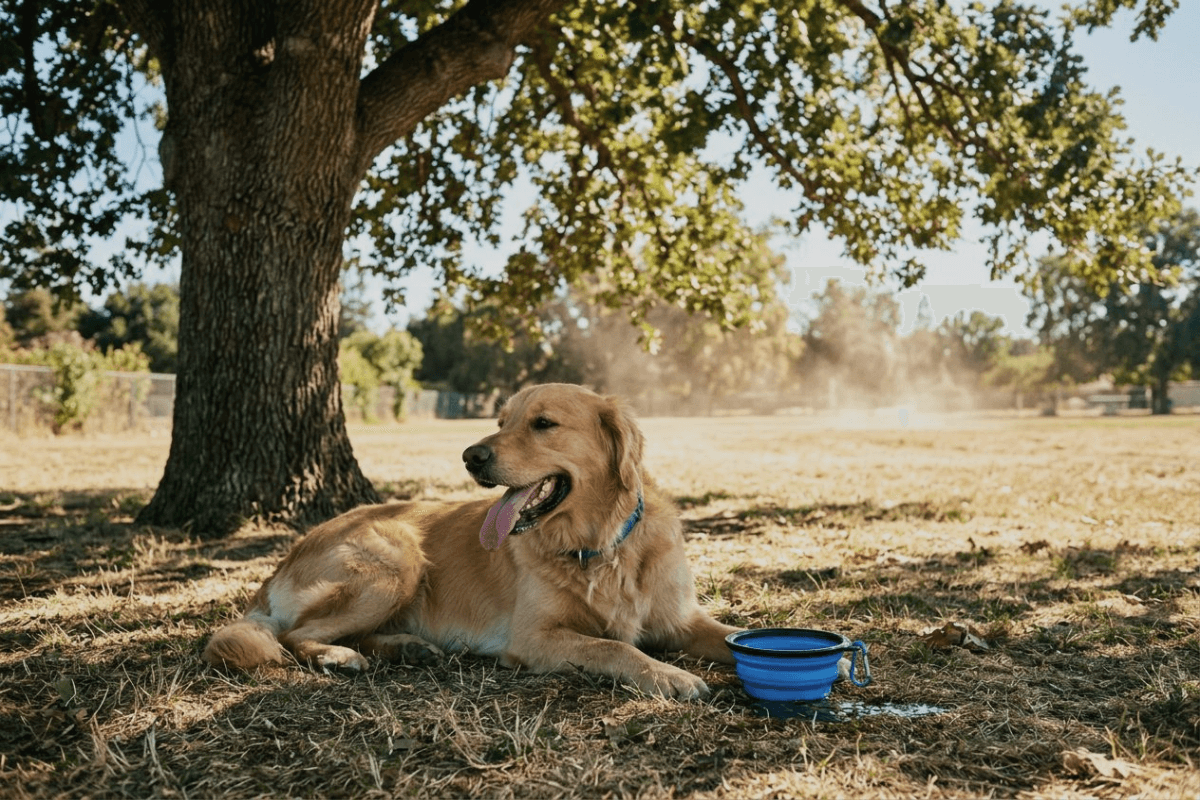
Dogs cool themselves badly
People sweat across the whole body, and evaporation does the work. Dogs sweat only from their paw pads, and rely almost entirely on panting: moving air over a wet tongue and respiratory tract. Panting is far less efficient than sweating, and it becomes less efficient still when the air is humid, because evaporation is what does the cooling.
A humid 80°F day is harder on a dog than a dry 90°F one. This is exactly the opposite of the intuition most owners bring from their own comfort.
The ground is hotter than the air
Asphalt, concrete, packed dirt, and artificial turf all absorb sun and hold heat far above the air temperature. The paw pads that provide the little sweating a dog does are pressed against that surface for the whole visit.
The practical test is to place the back of your hand flat on the surface and hold it there for seven seconds. If you can't, your dog shouldn't be standing on it. This works on parking lots, on the path to the park, and on the park's own surface, which for a fenced dog park is frequently gravel or artificial turf rather than grass.
Dogs don't self-regulate
A dog in a group at a park will keep running as long as the other dogs are running, well past the point where they'd have stopped alone. Play drive overrides fatigue, and the social pressure of a pack overrides both. You cannot rely on a dog to take themselves out of the game, and a happy dog and an overheating dog look very similar from thirty feet away.
Enforce breaks. Call your dog to shade, offer water, and make them stand still for a minute every fifteen. Most dogs resent it and most owners feel silly doing it.
Which dogs are at higher risk
- Flat-faced breeds. Bulldogs, pugs, boxers, and their relatives have compromised airways, and panting is exactly the mechanism they're worst at. They overheat at temperatures other dogs handle easily.
- Thick-coated northern breeds. Huskies, malamutes, and similar dogs are insulated for a climate they no longer live in.
- Overweight dogs, older dogs, and dogs with heart or airway conditions. Reduced reserve, in every sense.
- Very dark coats. Absorbed solar heat is not a small effect on a black dog in full sun.
Signs to act on
Frantic, noisy panting that doesn't settle when the dog stops moving. Thick, ropey drool. A tongue that is very wide and hanging unusually far out. Unsteadiness, glazed eyes, or a dog who lies down and doesn't want to get up. Vomiting or diarrhea at the park.
If you see these, get the dog into shade, offer water, wet them with cool, not ice-cold, water, particularly the belly, armpits, and paws, and contact a vet. Heat illness in dogs can progress quickly, and a dog who seems to recover can still be in trouble. This is a call-the-vet situation, not a wait-and-see one.
Timing beats everything
The whole problem disappears if you go early. In most of the country, the hour after sunrise is cool, the ground has released the previous day's heat, and dog parks are quiet enough that a nervous dog gets a better visit too. Evening is second best: the air cools before the ground does, so surfaces can still be hot at 7pm.
Each listing in this directory shows the typical high and low for the current month at that location, drawn from NOAA's 1991–2020 climate normals. It's a long-run average rather than a forecast, but it tells you what kind of month you're planning a visit in, and whether "early" needs to mean 7am or just "not noon".
Water at the park is not a plan
Many parks have taps or dog fountains, and we tag them where we can confirm it. Many of those are seasonal, broken, or turned off. Communal water bowls are also a route for transmitting illness between dogs. Bring your own water and your own bowl, and treat anything at the park as a bonus.